

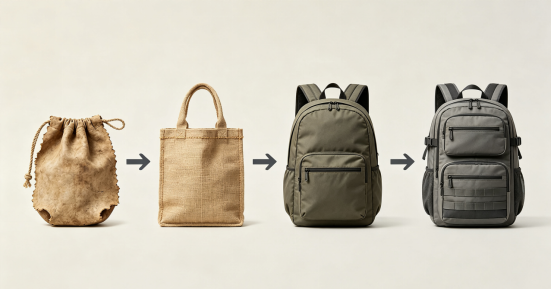
For a long time, backpacks were viewed as simple tools — containers designed to carry belongings. However, when we look back at their evolution, we discover that every major upgrade was not simply about making backpacks look better. Instead, it was a response to the increasing complexity of human lifestyles.
Entering 2026, this transformation has become even more apparent. Backpacks are evolving from simple “carrying tools” into personal systems, gradually taking on a role in managing our workflows and reducing cognitive load.
1. The Evolution of Backpacks: From Weight-Carrying Tools to Mobile Lifestyle Systems
①. Primitive Stage: Survival Tool (Pre-industrial Era)
The earliest forms of backpacks were essentially:
Animal skin bags
Simple fabric pouches
Basic carrying systems
Their purpose was straightforward:
Carry food, tools, and weapons.
The core logic of backpacks at this stage was simple:
Carry more. Carry easier. Survive.
There were no compartments, no design language, and no concept of efficiency.
②. Industrial Era: Functional Tools (Industrial Era)
With the rise of industrial society, backpacks began developing more structured designs:
Hiking backpacks
Military packs
School bags
The key change was:
Humans began moving in more predictable and repeated patterns.
Examples:
Going to school
Climbing mountains
Military operations
As a result, backpacks started introducing:
Main compartment
External attachment systems
Basic organization structures
However, the fundamental purpose remained:
“Carry more + withstand more.”
③. Information Era: EDC Tools (Digital Era)
With the rise of smartphones and digital devices, backpacks experienced their first major transformation.

People began carrying:
Laptops
Chargers
Multiple electronic devices
Accessories and cables
The concept of EDC (Everyday Carry) emerged.
The backpack’s role changed from:
“Something that stores items”
to:
“Something that supports continuous daily use.”
New problems appeared:
Tangled cables
Increasing need for device protection
Frequent access requirements
④. After the 2020s: The System Era
With the rise of remote work and multi-scenario urban lifestyles, one person may now move between:
Office
Coffee shop
Subway
Business trips
Gym
within a single day.
Backpacks began taking on a new role:
A mobile workstation + personal organization system
This is the foundation behind the rise of system backpacks.
2. The Psychology Behind Why We Need Structured Backpacks
Choosing a backpack is not only an aesthetic decision.
At a deeper level, it is closely connected to human psychology and how our brains manage information.
①. Cognitive Load Theory
Human attention and decision-making capacity are limited resources.
When your backpack lacks structure:
Every search becomes a small decision
Every item retrieval requires mental effort
Every time you dig through your bag, your focus is interrupted
Over time, this creates:
Accumulated cognitive fatigue
Problems with minimalist backpacks:
You must remember where everything is
You rely heavily on spatial memory
Organization becomes a recurring task
They may look simple, but they create hidden mental workload.
Advantages of structured backpacks:
Fixed locations
Predictable placement
Automatic retrieval paths
The real benefit is reducing the number of decisions you need to make.
②. Sense of Control
Psychology suggests that humans naturally prefer environments that feel predictable and controllable over environments that are completely open but chaotic.
Minimalist backpacks often create:
Freedom
Flexibility
Higher randomness
Structured backpacks create:
Predictability
A sense of order
Security
This explains why many people say after switching to an organized backpack:
“It has more structure, but somehow feels easier to use.”
③. The Psychology of Order and Reward
When the brain sees:
Every item has a designated place
Everything is visible when the backpack opens
it creates a subtle reward response.
This is not necessarily excitement or pleasure.
Instead, it produces:
Stability
Certainty
Control
This is one reason why structured backpacks often become something people “cannot go back from.”
3. From Tool Thinking to System Thinking: How Design Logic Has Changed
①. Old Logic: Container Thinking
Traditional backpack design focused on:
How much can it hold?
How durable is it?
How does it look?
Keywords:
Capacity、Material、Appearance
②. New Logic: System Thinking
Modern backpack design focuses on:
Is information flow smooth?
Is the access path optimized?
Is every item predictable?
Keywords:
Efficiency、Flow、Structure、System
4. The Core Structure of a System Backpack (2026 Standard)
Modern system backpacks generally follow four structural layers:
①. Digital Core Layer
Includes:
Laptop
Tablet
Chargers
The productivity center.
②. Fast Access Layer
Includes:
Phone accessories
Transit cards
Earphones
Reduces access time and unnecessary movements.
③. Organization Layer
Includes:
Stationery
Small tools
Accessories
Keeps daily items organized and easy to locate.
④. Lifestyle Expansion Layer
Includes:
Water bottle
Jacket
Food containers
Supports all-day movement between different scenarios.
5. Product Examples: The System Logic Behind Nayo Smart Herman Pro
Today’s backpack brands are responding to this shift toward system thinking in different ways.
By looking at representative products, we can understand how this philosophy is translated into real designs.
①. Nayo Smart Herman Pro: The Urban Efficiency Management System
While some backpacks simply divide space into compartments, the Herman Pro focuses on creating a personal efficiency system for modern professionals.
It represents the idea of reducing cognitive load through structured design.

180° L-Shaped Full Opening Design
This is not just an aesthetic choice.
It transforms the traditional “deep black hole” backpack structure into a flat, visible workspace.
When opened, your essential work tools become immediately visible.
Your brain no longer needs to search through spatial memory.
12+ Functional Compartments & Dedicated Tech Storage
The organization follows a clear system:
Digital Core Layer → Fast Access Layer → Daily Organization Layer
Power adapters, mice, pens, documents, and water bottles all have designated locations.
Everything has its own place.
Psychological Benefit
The Herman Pro provides a strong sense of control.
With repeated use, retrieval actions become muscle memory, reducing hidden mental effort during:
Urban commuting
Business travel
Multi-scenario transitions
②. Peak Design Everyday Backpack: The Dynamic Creator System
Peak Design approaches the system backpack from another perspective:
high-value equipment protection in constantly changing environments.
Designed for photographers, filmmakers, and creators, it works like a mobile equipment studio.
FlexFold Origami-Inspired Divider System
Creators often carry equipment with constantly changing sizes:
70–200mm lenses
Mirrorless cameras
Drones
Stabilizers
Peak Design uses flexible dividers inspired by origami.
The internal space is not fixed.
Instead, it can be rearranged like building blocks.

Dual-Side Quick Access
For photographers, moments cannot always wait.
Instead of removing the backpack completely:
Swing it around
Open the side access
Retrieve equipment within seconds
Psychological Benefit
It provides confidence and control in unpredictable creative environments.
Expensive equipment stays protected, and creators reduce the risk of missing important moments while searching for gear.
6. Future Trends: Backpacks Will Become More Like Operating Systems
Looking ahead, backpacks are evolving in three major directions:
①. From Space to Workflow
Old backpacks focused on:
“How much can it carry?”
Future backpacks will focus on:
“How quickly can you access what you need?”
Whether it is:
A commuter compartment system
A side-access camera system
future designs will continue shortening the physical distance between:
“I need something” → “I have it in my hand.”
②. From Rigid Structure to Adaptive Structure
Future system backpacks may combine:
Lightweight flexibility
Structural protection
They may stay slim when empty but dynamically expand when carrying:
Digital devices
Photography equipment
Daily essentials
The internal structure could adapt like biological systems, providing protection without unnecessary bulk.
③. From Physical Carrier to Digital Companion
As smart devices become more common, backpacks may eventually connect with:
AI wearables
Smart glasses
Smartphones
For example:
A backpack could remind you through your earbuds:
“You left your laptop charger at home.”
or:
“Your camera battery is missing.”
The backpack could become an extension of your personal workflow system.
7. Conclusion
The evolution of backpacks reflects the increasing complexity of human lifestyles.
Past:
Solving the problem of carrying.
Present:
Solving the problem of efficiency.
Future:
Solving the problem of cognitive burden.
In the 2026 urban commuting environment:
Minimalist backpacks = Reduce physical burden
System backpacks = Reduce mental burden
The biggest change is this:
A backpack is no longer just a tool for carrying things.
It is becoming a system designed to help people organize, move, and manage modern life.
Share:
Minimalist Backpack vs Multi-Compartment Backpack: Which One Suits You?
Unisex Guide: How to Organize Your Everyday Commute Essentials with One Sling Bag